Stillwater, MN · Garage Door Service
Mahtomedi homes mostly date to 1989, a decade newer than Stillwater's median. That gap changes which springs, openers, and tracks fail first here.
Arden Hills homes cluster around a median build year of 1977, almost exactly matching the wider service area's 1978 median drawn from stock built between 1950 and 2002. That near match matters more than it sounds. A house built in 1977 usually shipped with a torsion spring system on a steel sectional door, aluminum or galvanized track, and an opener that has likely already been replaced once or is due. If your house here still has its original hardware, you're looking at a spring rated for a door that's heavier than the newer insulated panels sold today, and a drum system that doesn't match parts on the shelf at most supply houses. We see this pattern across the era: the spring is fine until it isn't, and when it goes, it goes on both sides of the shaft at once because the metal fatigues evenly. Panels from this period also tend to be single-layer steel without foam backing, which shows up as dents that don't pop back and bottom sections that rust from the inside out where the old weatherstrip trapped moisture.
The homes going up in Arden Hills through the 1970s were mostly attached one- and two-car garages built to the standards of that decade, not to today's code. That's not a knock on the construction, it's just a different set of assumptions. Door openings were sized for the panel styles sold then, so a straight swap to a modern door sometimes means adjusting the jamb or header rather than a drop-in replacement. Minnesota's climate band is classified cold and severe, and homes of this vintage weren't built with the sealing standards that later insulation codes require. On a door and track system that's now decades old, that shows up as stiff rollers in January, a bottom seal that's lost its flex, and a torsion spring that loses tension faster in temperature swings than a newer galvanized coil would. None of that is unique to any one house on the block. It's the shared condition of a neighborhood that mostly went up in the same short window, which is why the failures tend to cluster by age rather than by address.
We run out of Stillwater, and Arden Hills sits about 16 miles from the shop. We don't keep a truck stationed here, so every call is a scheduled run rather than a drop-in, and we tell you that up front rather than promise a same-hour arrival we can't back up. What we can do is plan the truck's route around the day's other calls in the towns between here and Stillwater, so a job in Arden Hills often gets paired with one nearby rather than sent out alone. If you're dealing with a door that won't close and a car trapped inside, say so when you call, since a stuck door affects how we sequence the day. If it's a routine spring swap or opener install, we'll set a window that works for your schedule instead of squeezing it into a gap between other jobs.
Arden Hills is inside the range we cover, but it sits closer to the outer edge than to the middle. Our service area runs from towns just a couple of miles from Stillwater, like Oak Park Heights and Bayport, out through Lake Elmo, Mahtomedi, and Vadnais Heights, to towns near 19 miles out such as Mounds View, St. Anthony, Columbus, and Mendota Heights. At 16 miles, Arden Hills falls near that far boundary rather than at the center of it. We don't cover ground past that ring, and we won't quote a job outside it just to take the work. If you're near the line, the honest answer is to call and ask rather than assume, since coverage is drawn by drive time and route, not a strict circle on a map.
No. We're based in Stillwater and drive out to Arden Hills for scheduled jobs, about 16 miles each way. We don't keep a depot or a truck stationed here, so every visit is planned rather than a walk-in stop.
It's common. Most homes here were built around 1977, and an opener from that era is well past its expected service life. If it's the original unit, replacement usually makes more sense than repair once a part fails.
Cold makes steel less flexible, and this area's climate band is classified cold and severe. A torsion spring that's already fatigued from decades of cycles tends to snap in a cold stretch rather than during a mild one, since the metal has less give.
We'll try to fit an urgent call into the day's route, but we don't promise a same-hour arrival from Stillwater at this distance. Tell us it's urgent when you call and we'll place it as early in the run as we can.
Call now or request a free quote - same-day service on most repairs, upfront written pricing.
Stillwater's housing stock runs older overall, with a median build year around 1978 across the wider service area. Mahtomedi sits noticeably newer, with a median build year of 1989. That decade matters more than it sounds like it should. Houses built in the late 1980s came standard with torsion springs and chain or belt-drive openers rather than the older extension-spring setups you still find on the 1960s and 70s stock closer to Stillwater. The failure point shifts too. On these newer builds, we see less of the seized, decades-old hardware and more worn drive gears, stretched belts, and openers hitting the end of their circuit boards' service life. Steel sectional doors from this era also used lighter-gauge panels than what came before, so denting from a car bumper or a stray basketball shows up more here than snapped cables. The cold band this whole area sits in still applies - a 1989 door with a torsion spring loses tension the same way an older one does when temperatures drop hard. But the specific part that fails first, and how it fails, tracks with when the house went up, not just where it sits.
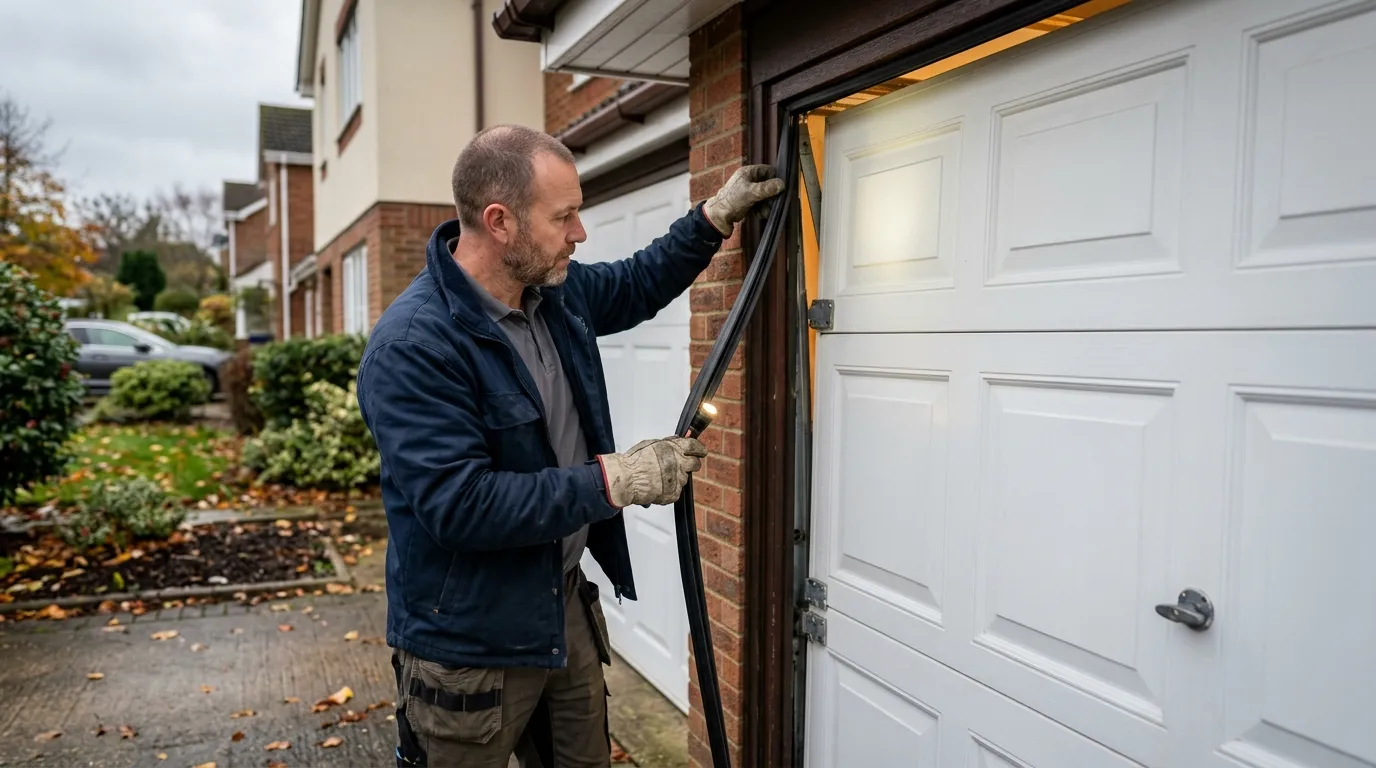
A homeowner can safely handle a few things on a door this age: swapping worn weatherstripping, lubricating rollers and hinges, tightening loose bolts on the track, and resetting an opener's travel limits if the door isn't closing all the way. What you shouldn't touch is the torsion spring itself. On a standard door for a house this size, that spring is under enough tension to break a bone or worse if it lets go while you're working on it. If your opener is a chain or belt-drive unit original to a late-80s build, the logic board may also be near end of life, and swapping boards without knowing the wiring gauge and travel settings for that specific model can strand you mid-job. If the door won't budge, or it opens crooked on one side, stop and call - that's almost always a cable or spring problem, not a fix-it-yourself afternoon.
Most single-spring replacements and opener repairs on a door this age run under two hours once we're on site. Panel swaps take longer if we have to match a discontinued color or profile from a late-1980s builder line - that part sometimes has to be special-ordered, which is the honest limitation here: we can't promise same-day on a panel we don't stock. Cable and roller jobs are quicker, usually done within the hour. We travel the 7 miles from Stillwater, so factor that into when we can get there, not into how long the repair itself takes once the truck's in the driveway.
Tell us the door's rough age (this side of town, that's usually late 1980s) and what it's doing - won't open, opens unevenly, makes a grinding noise, or the opener runs but the door doesn't move. That narrows down whether we're bringing spring stock, a replacement drive gear, or just a service kit. We book the visit from Stillwater, so a clear description up front saves a second trip if the part on the truck doesn't match what's actually failing.
We diagnose on site first - most of the time that means checking spring tension, opener drive components, and track alignment before touching anything. On a torsion spring, we replace it with a properly sized spring rated for the door's weight and cycle count, not a generic stand-in. For opener issues on units from this build era, we check the logic board and drive gear before assuming the whole unit needs replacing; sometimes it's just the gear kit. If a panel's damaged and matching stock isn't available, we'll tell you that upfront rather than quote a job we can't finish on the day. The area's cold band means we also check weatherstripping and bottom seal fit while we're there, since a gap that's fine in summer becomes a real heat-loss problem once temperatures drop.
It might not be older - it's likely a different generation of hardware. Mahtomedi's housing runs newer on average (median build year 1989) than the broader service area's 1978 median, so openers and springs installed here are often a decade newer in design, not age, which changes what parts we bring.
No. We're based in Stillwater and travel the roughly 7 miles out to Mahtomedi for calls. There's no local branch here, just a truck coming from Stillwater with the parts matched to what you describe on the phone.
Sometimes, if the dent is shallow and the panel isn't cracked. Late-1980s steel sectional doors used lighter-gauge panels than earlier builds, so dents show more easily but a shallow one can often be pulled rather than swapped outright.
This area sits in a severe cold climate band, and spring steel loses tension as temperature drops. We don't have a specific failure threshold to quote, but a spring that's already worn is far more likely to snap on a hard cold morning than in mild weather.