Stillwater, MN · Garage Door Service
Stillwater homes built between 1950 and 2002 often carry doors and openers past their service life. See what a new install involves, parts to cost.
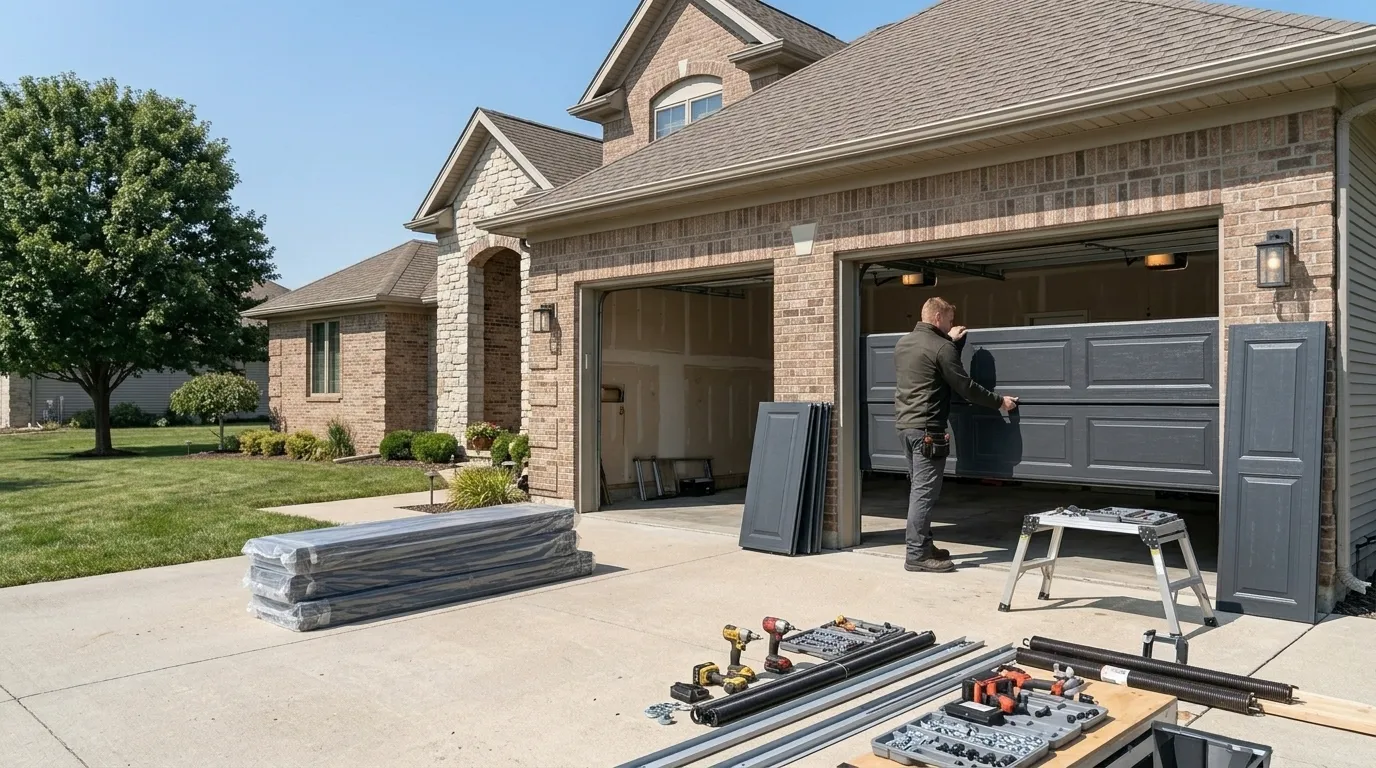
Stillwater's housing stock runs mostly 1950 to 2002, with the median build year sitting around 1978. That means a big share of garages still have the door and opener that came with the house, or a first replacement installed decades ago. Steel panels from that era were built thin, without foam insulation, and openers used chain drives with basic gear sets that were never designed to run for fifty winters.
Add in the cold-severe climate band Stillwater sits in, and you get a specific failure pattern: steel contracts hard in deep cold, seams that were fine in July start gapping in January, and old nylon opener gears crack when they're asked to lift a door that's now slightly warped or heavier from moisture-soaked wood trim. None of that is a defect in any one door - it's what happens to 1970s-era hardware after decades of hard freeze-thaw cycles.
We're not saying every old door needs replacing tomorrow. Some are still sound and just need a service call. But once a door is fighting the cold instead of sealing against it, patching stops making sense and installing a door built for the climate band we're actually in starts to.
Because most of the homes we work on across this stretch - the same 24 named areas that make up the bulk of the local 1960s and 70s housing stock - use a narrow band of standard door widths, we keep parts sized for that stock on the truck rather than special-ordering for every job. That includes insulated steel sections rated for cold-severe conditions, low-temperature torsion springs that won't go brittle in a January garage, and weatherstrip compounds that stay flexible below zero instead of cracking.
We also stock openers with steel gear drives rather than the nylon gear sets that were standard when a lot of these garages were built, since nylon is one of the first things to fail once cold cycling starts. For openings that match the common widths from that era, we can usually turn an install around fast because we're not waiting on a supplier.
Where we don't stock parts is anything custom - odd-sized openings, arched carriage doors, or specialty finishes. Those get ordered and take longer, and we'll tell you that up front rather than promise a date we can't hit.
The signs are usually gradual, not sudden. A door that used to close flush now leaves daylight along the bottom seal, especially once temperatures drop and the steel contracts. Openers start straining - you'll hear the motor labor for an extra second before the door moves, which is often a gear giving out rather than the opener itself dying.
On older single-layer steel doors, you'll sometimes see condensation and frost forming on the inside face during a cold stretch, because there's no insulation layer to stop the temperature swing. That moisture is what eventually rusts out the bottom panel from the inside, which is a different problem than a dent or a ding on the outside.
Another pattern specific to homes from the 1960s and 70s stock: torsion springs sized for the lighter doors of that era get swapped out over the years for heavier replacement doors, and the springs never get resized to match. That shows up as a door that's hard to lift by hand or an opener that runs hot trying to compensate.
We're not going to quote a number here that isn't tied to your actual door, opening, and insulation choice - a single-panel steel door and a two-panel insulated carriage-style door aren't priced the same job, and neither is a standard width versus something oversized. What we can tell you is what drives the number: door material and R-value, whether the opener is included or reused, and whether the existing track and hardware can be kept or need replacing along with the door.
Given the median household income across this service area sits around $108,560, most of the jobs we quote land in a mid-range insulated steel door rather than either the bare-bones or the high-end custom end of the catalog - that's just what fits the housing stock and what most owners are asking for.
One limitation worth saying plainly: if your opening is a nonstandard size, or you want a wood or glass-panel custom door, that's a special order with a longer lead time than a standard replacement. We'd rather tell you that before the job starts than after.
There's no fixed age, but doors from the 1960s-70s stock common around here are often single-layer steel with no insulation, and once the seals and springs are failing along with the panel, patching one thing at a time usually costs more over a year than a new install.
Yes, if it's an insulated door with weatherstripping rated for a cold-severe climate. Older single-layer steel doors have no thermal break, so an unheated garage stays close to outdoor temperature all winter regardless of what you do to the seals.
We install openers as part of a door job when the existing one is nylon-geared or undersized for the new door's weight. If your current opener is a steel-gear model in good shape, we can often reuse it and just install the door.
Standard widths that match the common sizes used in this area's housing stock are usually the fastest turnaround since we stock those parts. Custom or oversized openings require a special order and take longer.
Call now or request a free quote - same-day service on most repairs, upfront written pricing.