Stillwater, MN · Garage Door Service
Torsion springs, tracks, and openers on Stillwater's 1960s-90s housing stock fail in patterns tied to the cold. We stock the parts that match.
Most homes near Stillwater went up between 1950 and 2002, with the median build year sitting at 1978. That puts a lot of original torsion hardware on headers that were sized for the lighter, thinner doors of that era, not the insulated steel panels a lot of owners have swapped in since. Across the 24 named areas that make up this service territory, the bulk of the stock dates to the 1960s and 70s, which means a specific generation of spring winds, drum sizes, and track gauges keeps showing up on our service calls.
Then there's the climate. Stillwater sits in a cold-severe band, and that swing between summer heat and deep winter cold is what fatigues torsion springs years before they'd give out somewhere milder. Steel contracts in the cold, cycle counts drop, and a spring rated for ten thousand cycles in a temperate climate might not see eight thousand here. Cold also stiffens door seals and lubricant, so openers strain harder on the first cold-morning cycle of the day - often the moment a weak spring finally lets go. None of this is a defect. It's just what forty-plus winters do to hardware nobody's replaced.
Because so much of the local stock traces back to that 1960s-90s build window, we keep torsion springs, drums, and cable in the sizes that actually match what's on these doors - not just whatever's common nationally. That includes standard-lift torsion setups from the older builds and the heavier-duty springs that later retrofits and steel-door upgrades called for.
We also carry rollers and hinges rated for cold-climate service, since standard nylon rollers get brittle and crack faster in a severe-cold band than they would somewhere warmer. Same goes for weatherstripping and bottom seals - the cold-rated versions hold their flex instead of going stiff and letting drafts through.
One honest limit: if a door needs a spring size or a track profile that's out of production - which happens on some of the oldest homes in this window - that part isn't sitting on the truck. We'll tell you straight if it's a special-order item and give you the real timeline instead of guessing.
The classic sign is a door that won't budge and an opener that hums but doesn't lift - that's usually a broken torsion spring, and on a cold morning it's often the first cycle of the day that finally snaps it. You might also notice the door sitting crooked in the frame, cables looking loose on one side, or a loud bang from the garage overnight as the spring lets go under tension.
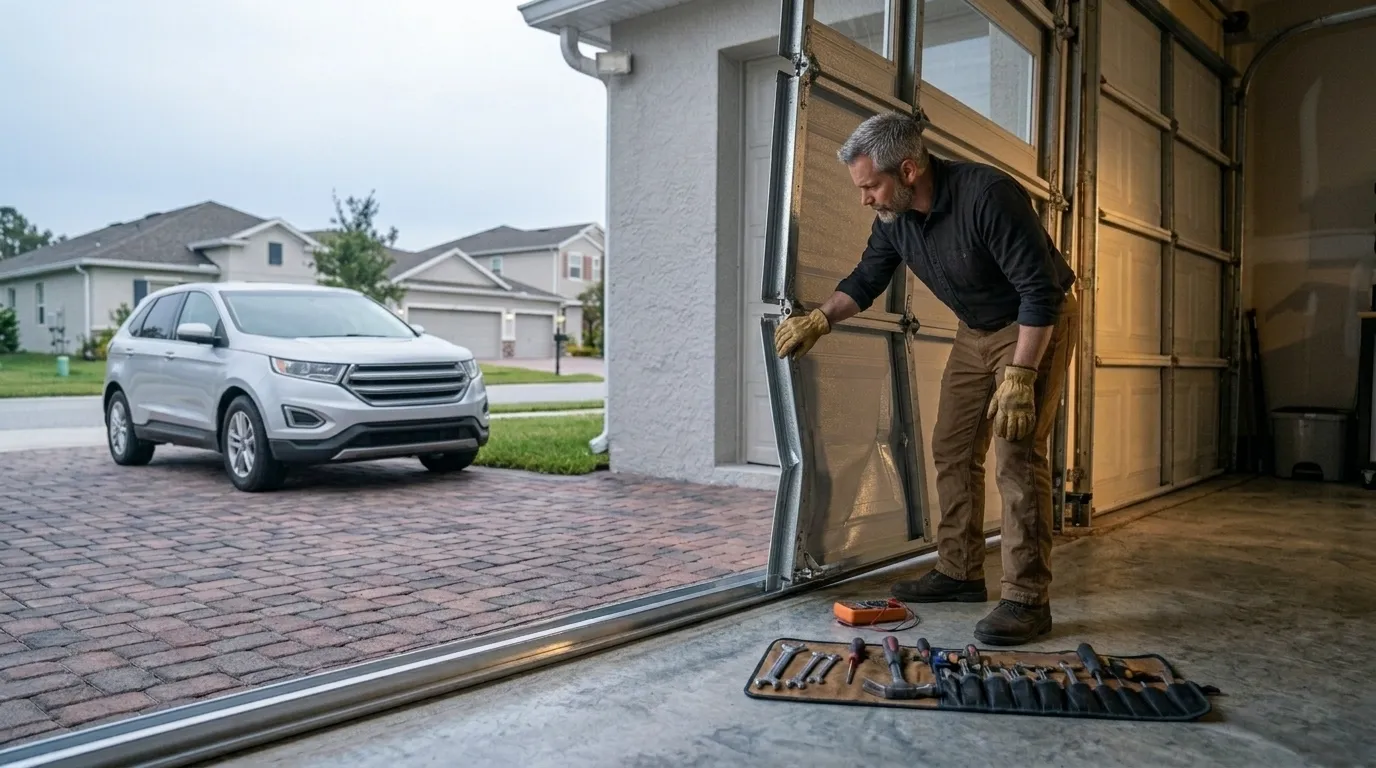
On older tracks, cold makes the rollers bind before they break, so you'll hear grinding or see the door hesitate partway up before an opener strains and reverses. Bent track from a slightly frozen door forced open with the emergency release is another one we see every winter - the door's stuck, someone pulls the red cord, and the panel comes down crooked because the springs are gone, not the opener.
If your door is fighting you more in January than it did in August, that's the cold-cycle fatigue talking, not a coincidence.
We don't have a flat number to quote you here, because torsion spring jobs vary by spring size, door weight, and whether one or both springs need replacing - and on the oldest doors in this area, sometimes a track or hinge comes along for the ride. What we can tell you is how we think about it: with 32,692 owner-occupied houses across a service area of 61,080 households, a lot of these doors are original equipment nobody's touched since the house went up, and repair vs. replace comes down to age and how many other parts are already worn.
Median household income across this area runs $108,560, and that's part of why, once a door's hardware is failing in more than one place, full replacement often pencils out better than a string of one-off repairs. We'll walk you through what we see and give you the real number for your door once we're looking at it - not before.
Cold makes steel more brittle and stiffens the grease inside the coil, so the spring works harder on every cycle. In Stillwater's cold-severe climate, that fatigue adds up faster than in a milder region, and a lot of springs finally give out on that first cold morning cycle.
It's possible. A large share of homes across this area were built in the 1960s and 70s, and plenty still have the original torsion hardware. If nobody's replaced the spring since the house was built, it's worth having it checked before it breaks on its own schedule.
We stock torsion springs, drums, cable, and cold-rated rollers and seals sized for the build era that's common across this area. On rare occasions, an out-of-production track profile or spring size on one of the oldest homes needs to be special-ordered, and we'll tell you upfront if that's the case.
If it's just a broken spring on an otherwise sound door, that's a straightforward repair. If the track's bent, the rollers are shot, and the opener's straining too, replacement often costs less over time than fixing each part separately. We'll give you a straight read once we've looked at the door.
Call now or request a free quote - same-day service on most repairs, upfront written pricing.