Stillwater, MN · Garage Door Service
Mahtomedi's 2,927 households sit mostly on 1980s-built garages. We explain what wears out rollers here and how a Stillwater-based crew handles the job 7 miles out.
Arden Hills homes cluster around a median build year of 1977, almost exactly matching the wider service area's 1978 median drawn from stock built between 1950 and 2002. That near match matters more than it sounds. A house built in 1977 usually shipped with a torsion spring system on a steel sectional door, aluminum or galvanized track, and an opener that has likely already been replaced once or is due. If your house here still has its original hardware, you're looking at a spring rated for a door that's heavier than the newer insulated panels sold today, and a drum system that doesn't match parts on the shelf at most supply houses. We see this pattern across the era: the spring is fine until it isn't, and when it goes, it goes on both sides of the shaft at once because the metal fatigues evenly. Panels from this period also tend to be single-layer steel without foam backing, which shows up as dents that don't pop back and bottom sections that rust from the inside out where the old weatherstrip trapped moisture.
The homes going up in Arden Hills through the 1970s were mostly attached one- and two-car garages built to the standards of that decade, not to today's code. That's not a knock on the construction, it's just a different set of assumptions. Door openings were sized for the panel styles sold then, so a straight swap to a modern door sometimes means adjusting the jamb or header rather than a drop-in replacement. Minnesota's climate band is classified cold and severe, and homes of this vintage weren't built with the sealing standards that later insulation codes require. On a door and track system that's now decades old, that shows up as stiff rollers in January, a bottom seal that's lost its flex, and a torsion spring that loses tension faster in temperature swings than a newer galvanized coil would. None of that is unique to any one house on the block. It's the shared condition of a neighborhood that mostly went up in the same short window, which is why the failures tend to cluster by age rather than by address.
We run out of Stillwater, and Arden Hills sits about 16 miles from the shop. We don't keep a truck stationed here, so every call is a scheduled run rather than a drop-in, and we tell you that up front rather than promise a same-hour arrival we can't back up. What we can do is plan the truck's route around the day's other calls in the towns between here and Stillwater, so a job in Arden Hills often gets paired with one nearby rather than sent out alone. If you're dealing with a door that won't close and a car trapped inside, say so when you call, since a stuck door affects how we sequence the day. If it's a routine spring swap or opener install, we'll set a window that works for your schedule instead of squeezing it into a gap between other jobs.
Arden Hills is inside the range we cover, but it sits closer to the outer edge than to the middle. Our service area runs from towns just a couple of miles from Stillwater, like Oak Park Heights and Bayport, out through Lake Elmo, Mahtomedi, and Vadnais Heights, to towns near 19 miles out such as Mounds View, St. Anthony, Columbus, and Mendota Heights. At 16 miles, Arden Hills falls near that far boundary rather than at the center of it. We don't cover ground past that ring, and we won't quote a job outside it just to take the work. If you're near the line, the honest answer is to call and ask rather than assume, since coverage is drawn by drive time and route, not a strict circle on a map.
No. We're based in Stillwater and drive out to Arden Hills for scheduled jobs, about 16 miles each way. We don't keep a depot or a truck stationed here, so every visit is planned rather than a walk-in stop.
It's common. Most homes here were built around 1977, and an opener from that era is well past its expected service life. If it's the original unit, replacement usually makes more sense than repair once a part fails.
Cold makes steel less flexible, and this area's climate band is classified cold and severe. A torsion spring that's already fatigued from decades of cycles tends to snap in a cold stretch rather than during a mild one, since the metal has less give.
We'll try to fit an urgent call into the day's route, but we don't promise a same-hour arrival from Stillwater at this distance. Tell us it's urgent when you call and we'll place it as early in the run as we can.
Call now or request a free quote - same-day service on most repairs, upfront written pricing.
Mahtomedi is a small town by household count - 2,927 of them - and the garages behind those houses mostly went up around 1989, which puts a lot of doors here on late-80s steel track and nylon roller setups rather than the older galvanized rollers you'd find on a 1960s build. Nylon holds up fine for years, but it gets brittle in a hard winter, and this area sits in a cold-severe climate band, so repeated freeze-thaw cycles on the track edges are what actually chews through a roller stem over time, not just miles of use. On a town this size, we don't see a flood of different eras mixed together the way you might in an older suburb - most of the calls we get from here are the same failure pattern: a stem that's worn oval-shaped inside a nylon wheel, or a roller that's cracked clean through where the shaft meets the wheel. Once one roller goes, the door starts pulling unevenly in the track, which is usually when people call - not when the roller first started squeaking. If the door's original to a house built around 1989, the rollers are past due even if they haven't failed yet.
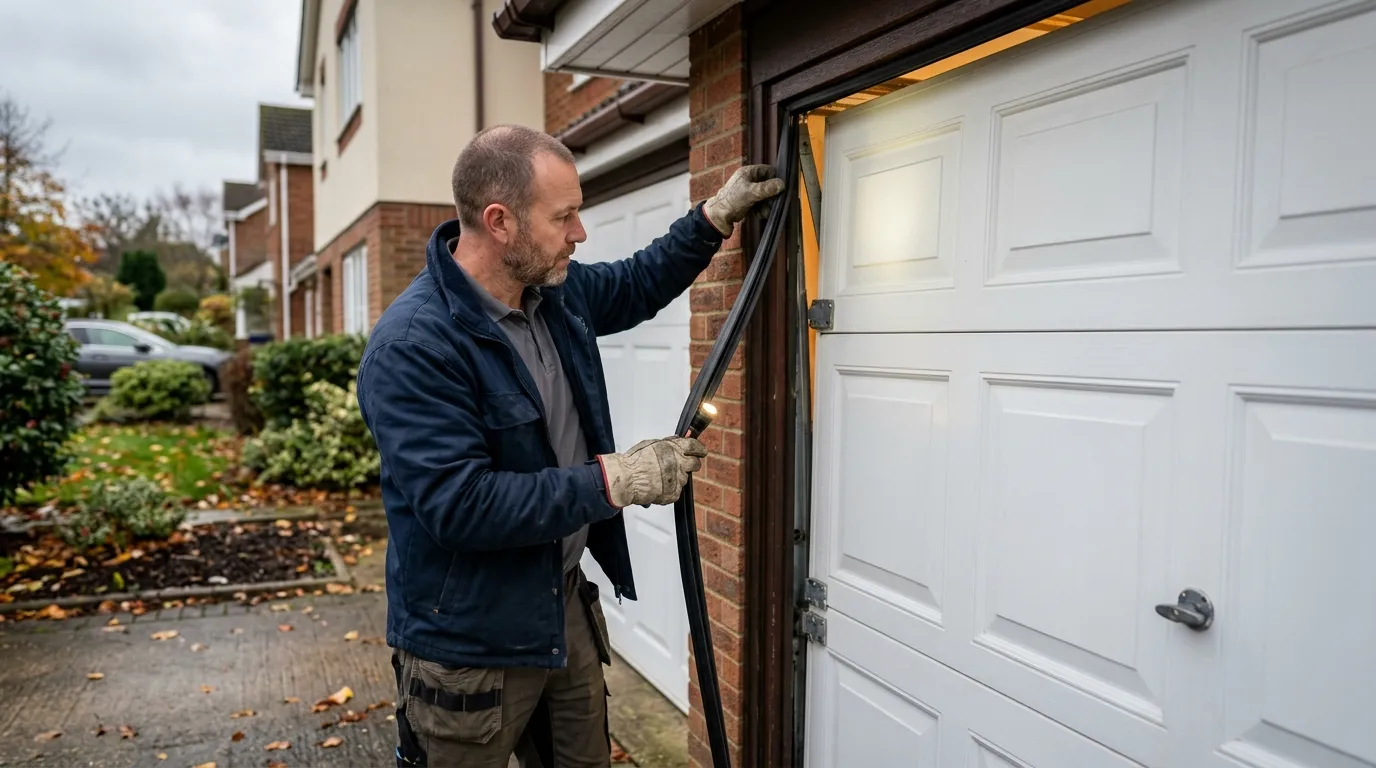
Swapping a roller isn't the hardest job on a garage door, but it's not a five-minute fix either. You have to release track tension safely, pull the hinge or end bracket, and get the roller stem out without bending the track - bend it and now you've got a bigger repair than the one you started with. If it's the bottom roller near the cable and spring assembly, we'd rather you didn't touch it without knowing exactly what's under tension. If it's a middle or top-section roller and you've got the right tools and some patience, it's doable. We'll say plainly: this is one of the more DIY-friendly garage door repairs there is, but a botched attempt on a torsion side turns a $20 part into a service call anyway.
A straightforward roller swap - one or two rollers on a residential door - is usually a same-visit job once we're on site. Full sets take longer since every hinge point on both sides needs to come apart and go back together correctly, and steel rollers with sealed bearings take a bit more care than the nylon ones they're often replacing. We're coming from Stillwater, about 7 miles out, so figure that travel into how the day's scheduled - it doesn't change the work time on your driveway, just when we can slot it in.
Tell us the roller material you've got if you know it - nylon or steel - and how many are giving you trouble, and we can usually bring the right parts on the first trip instead of guessing. Given the income and housing profile out this way, most of what we replace is upgraded to sealed steel rollers rather than putting nylon back in, since they outlast the cold-weather brittleness that got the original set in the first place. You can see general service coverage for the area on our Mahtomedi page, and if you want the fuller writeup on how we handle roller jobs generally, that's on the Stillwater roller replacement page.
We release the door safely, pull the section with the bad roller, swap the stem and wheel, and check the track alignment on that side before closing it back up - a new roller riding in a track that's slightly bent will just wear out again fast. If we're doing a full set, we do it a hinge at a time so the door stays supported and square the whole way through, rather than dropping the whole thing loose at once. Steel rollers with sealed bearings are what we recommend for this climate; they run quieter and don't crack the way nylon does once temperatures swing hard. One honest limit here: if the track itself is bent or rusted through, roller replacement alone won't fix the noise or the binding - that's a track repair, and we'll tell you straight if that's what's actually going on before we replace parts that won't solve it.
If the door judders or grinds at the same spot every time and you can see a roller wheel that's cracked, flat-spotted, or loose on its stem, it's the roller. If the noise happens at a different spot each cycle or the door leans in the opening, that's more likely a bent track, which is a separate repair.
Steel rollers with sealed bearings generally outlast nylon in this cold-severe climate band, since nylon can get brittle and crack after repeated hard freezes. If your door is original to a late-80s build, we'll usually recommend switching over rather than replacing nylon with nylon.
No - we run out of Stillwater, about 7 miles from Mahtomedi, and travel out for scheduled jobs. There's no local branch or drop-in counter here, just a crew that comes to you.
Yes, if the rest of the rollers are in decent shape. We'll look at wear on the others while we're there and tell you honestly if they're close enough behind that it makes sense to do them all at once instead of coming back in six months.