Stillwater, MN · Garage Door Service
Torsion spring repair for Mahtomedi's newer housing stock, built mostly after 1989. We travel 7 miles from Stillwater to fix or replace springs that finally give out.
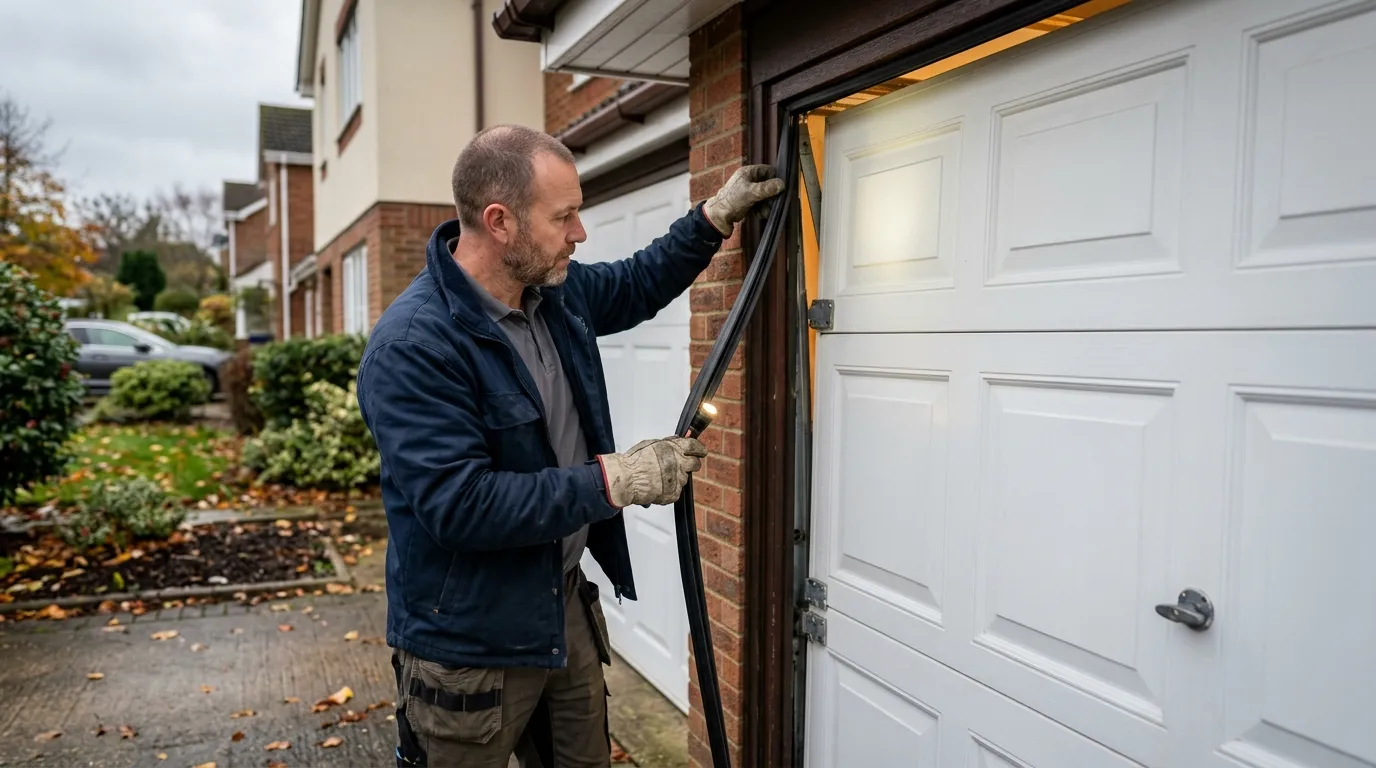
Arden Hills homes cluster around a median build year of 1977, almost exactly matching the wider service area's 1978 median drawn from stock built between 1950 and 2002. That near match matters more than it sounds. A house built in 1977 usually shipped with a torsion spring system on a steel sectional door, aluminum or galvanized track, and an opener that has likely already been replaced once or is due. If your house here still has its original hardware, you're looking at a spring rated for a door that's heavier than the newer insulated panels sold today, and a drum system that doesn't match parts on the shelf at most supply houses. We see this pattern across the era: the spring is fine until it isn't, and when it goes, it goes on both sides of the shaft at once because the metal fatigues evenly. Panels from this period also tend to be single-layer steel without foam backing, which shows up as dents that don't pop back and bottom sections that rust from the inside out where the old weatherstrip trapped moisture.
The homes going up in Arden Hills through the 1970s were mostly attached one- and two-car garages built to the standards of that decade, not to today's code. That's not a knock on the construction, it's just a different set of assumptions. Door openings were sized for the panel styles sold then, so a straight swap to a modern door sometimes means adjusting the jamb or header rather than a drop-in replacement. Minnesota's climate band is classified cold and severe, and homes of this vintage weren't built with the sealing standards that later insulation codes require. On a door and track system that's now decades old, that shows up as stiff rollers in January, a bottom seal that's lost its flex, and a torsion spring that loses tension faster in temperature swings than a newer galvanized coil would. None of that is unique to any one house on the block. It's the shared condition of a neighborhood that mostly went up in the same short window, which is why the failures tend to cluster by age rather than by address.
We run out of Stillwater, and Arden Hills sits about 16 miles from the shop. We don't keep a truck stationed here, so every call is a scheduled run rather than a drop-in, and we tell you that up front rather than promise a same-hour arrival we can't back up. What we can do is plan the truck's route around the day's other calls in the towns between here and Stillwater, so a job in Arden Hills often gets paired with one nearby rather than sent out alone. If you're dealing with a door that won't close and a car trapped inside, say so when you call, since a stuck door affects how we sequence the day. If it's a routine spring swap or opener install, we'll set a window that works for your schedule instead of squeezing it into a gap between other jobs.
Arden Hills is inside the range we cover, but it sits closer to the outer edge than to the middle. Our service area runs from towns just a couple of miles from Stillwater, like Oak Park Heights and Bayport, out through Lake Elmo, Mahtomedi, and Vadnais Heights, to towns near 19 miles out such as Mounds View, St. Anthony, Columbus, and Mendota Heights. At 16 miles, Arden Hills falls near that far boundary rather than at the center of it. We don't cover ground past that ring, and we won't quote a job outside it just to take the work. If you're near the line, the honest answer is to call and ask rather than assume, since coverage is drawn by drive time and route, not a strict circle on a map.
No. We're based in Stillwater and drive out to Arden Hills for scheduled jobs, about 16 miles each way. We don't keep a depot or a truck stationed here, so every visit is planned rather than a walk-in stop.
It's common. Most homes here were built around 1977, and an opener from that era is well past its expected service life. If it's the original unit, replacement usually makes more sense than repair once a part fails.
Cold makes steel less flexible, and this area's climate band is classified cold and severe. A torsion spring that's already fatigued from decades of cycles tends to snap in a cold stretch rather than during a mild one, since the metal has less give.
We'll try to fit an urgent call into the day's route, but we don't promise a same-hour arrival from Stillwater at this distance. Tell us it's urgent when you call and we'll place it as early in the run as we can.
Call now or request a free quote - same-day service on most repairs, upfront written pricing.
Mahtomedi's median household income sits at $132,326, well above the $108,560 average across our wider service area, and that changes the math on a broken spring. At this income level, most owners aren't trying to squeeze another decade out of a door that's already been rebuilt twice. If the opener, the track, and the cables are all still sound, a spring swap is an easy yes. If the door itself is showing its age, replacement usually pencils out faster than most people expect.
The hardware itself tells a different story from older parts of the service area. With 2,927 households and a median build year of 1989, most garage doors here went in with standard torsion spring setups on steel doors, not the older extension-spring or side-mount torsion hardware you find on houses built before 1978. That's good news for repair speed since torsion springs from this era are common sizes we carry, not obsolete parts we have to source. The failure pattern is usually straightforward: the spring fatigues from cycle count, not from a mismatched or ancient system fighting the opener.
A torsion spring is under enough tension to break a wrist or worse if the winding bars slip, and that risk doesn't change because your door is newer or your neighborhood is nicer. We're not going to talk you into a DIY job here. What you can safely check yourself: whether the door is a torsion system (spring mounted horizontally above the door, on a bar) or something else, whether the cables look frayed, and whether the door slams down hard or won't budge at all. That tells you what you're dealing with before you call.
The honest limitation: if your door was custom-sized or is an unusual imported brand, we may need to order a matching spring rather than pull one off the truck, and that adds a day or two. On a standard torsion setup common to houses built in this era, we're not waiting on parts.
Most spring jobs on the torsion systems typical of Mahtomedi's 1989-median housing stock run under an hour once the truck's on site, since the winding, balancing, and cable check follow a routine sequence on standard hardware. Two springs instead of one on a double door adds time but not much, since both come off and go back on in the same setup.
Winter changes the equation some. Our service area sits in a cold-climate zone with severe seasonal swings, and cold steel is stiffer and less forgiving to torque against, so we build in a little extra time for winding bars to seat properly and for the door to be tested through a full cycle before we call it done. We'd rather take the extra ten minutes than have you calling us back in a week.
We work out of Stillwater, 7 miles from Mahtomedi, and that drive is short enough that scheduling a spring repair here doesn't mean waiting around all day for a window. Tell us on the call whether the door is a single or double, torsion or extension, and roughly how old the opener is - that's usually enough for us to bring the right spring size the first trip instead of a return visit.
We don't keep a branch or drop-off counter in Mahtomedi itself; every job here is a truck roll from Stillwater. That's worth knowing if you're hoping to walk in same-day without a booked appointment - call ahead and we'll get you on the schedule.
We start by killing power to the opener and locking the door down before anyone touches a spring - that step matters more than any other in the job. From there it's winding bars, not vice grips or screwdrivers, to bring the new spring to the correct tension for your door's weight and size. On the torsion setups common to houses built around 1989, that's a known, standard tension we don't have to guess at.
Once the spring's on, we run the door through several full cycles, check the cables and rollers for wear while we're already in there, and rebalance if the door doesn't hold position halfway open. If we find a second problem while we're under the hood - a cracked roller, a bent track - we'll tell you what it is and what it costs before touching it, not after.
Age of the house doesn't protect the spring - cycle count does. A spring rated for around 10,000 cycles wears out on the same schedule whether the door is from 1970 or 1995. Mahtomedi's newer housing stock means the hardware is more standardized, which makes the fix faster, not less necessary.
For the torsion systems typical of houses built in Mahtomedi's era, yes, we generally carry matching sizes and don't need a second trip. Custom or older imported doors sometimes require ordering a part, but that's the exception here, not the rule.
If the door panels, track, and opener are sound, a spring repair is the cheaper and faster fix. If the door's already had multiple repairs or the panels are dented and warped, replacement often makes more financial sense - we'll tell you honestly which situation you're in.
We run out of Stillwater, about 7 miles away, so a Mahtomedi spring repair is a normal truck roll for us, not a special trip. There's no local branch or drop-off point in Mahtomedi itself.