Stillwater, MN · Garage Door Service
North Oaks homes mostly date to the mid-1980s. If your torsion spring is original, it's well past its rated cycle life. We drive out from Stillwater to fix it.
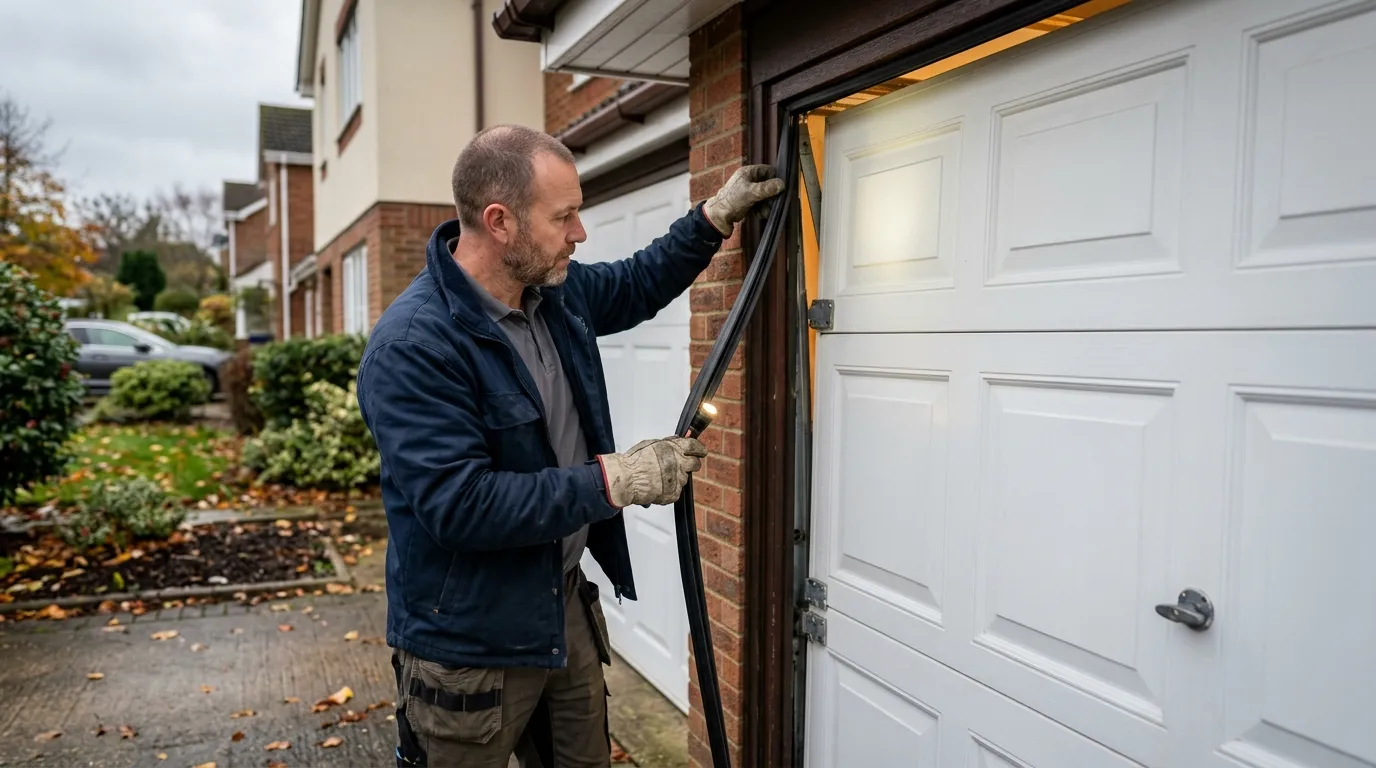
Arden Hills homes cluster around a median build year of 1977, almost exactly matching the wider service area's 1978 median drawn from stock built between 1950 and 2002. That near match matters more than it sounds. A house built in 1977 usually shipped with a torsion spring system on a steel sectional door, aluminum or galvanized track, and an opener that has likely already been replaced once or is due. If your house here still has its original hardware, you're looking at a spring rated for a door that's heavier than the newer insulated panels sold today, and a drum system that doesn't match parts on the shelf at most supply houses. We see this pattern across the era: the spring is fine until it isn't, and when it goes, it goes on both sides of the shaft at once because the metal fatigues evenly. Panels from this period also tend to be single-layer steel without foam backing, which shows up as dents that don't pop back and bottom sections that rust from the inside out where the old weatherstrip trapped moisture.
The homes going up in Arden Hills through the 1970s were mostly attached one- and two-car garages built to the standards of that decade, not to today's code. That's not a knock on the construction, it's just a different set of assumptions. Door openings were sized for the panel styles sold then, so a straight swap to a modern door sometimes means adjusting the jamb or header rather than a drop-in replacement. Minnesota's climate band is classified cold and severe, and homes of this vintage weren't built with the sealing standards that later insulation codes require. On a door and track system that's now decades old, that shows up as stiff rollers in January, a bottom seal that's lost its flex, and a torsion spring that loses tension faster in temperature swings than a newer galvanized coil would. None of that is unique to any one house on the block. It's the shared condition of a neighborhood that mostly went up in the same short window, which is why the failures tend to cluster by age rather than by address.
We run out of Stillwater, and Arden Hills sits about 16 miles from the shop. We don't keep a truck stationed here, so every call is a scheduled run rather than a drop-in, and we tell you that up front rather than promise a same-hour arrival we can't back up. What we can do is plan the truck's route around the day's other calls in the towns between here and Stillwater, so a job in Arden Hills often gets paired with one nearby rather than sent out alone. If you're dealing with a door that won't close and a car trapped inside, say so when you call, since a stuck door affects how we sequence the day. If it's a routine spring swap or opener install, we'll set a window that works for your schedule instead of squeezing it into a gap between other jobs.
Arden Hills is inside the range we cover, but it sits closer to the outer edge than to the middle. Our service area runs from towns just a couple of miles from Stillwater, like Oak Park Heights and Bayport, out through Lake Elmo, Mahtomedi, and Vadnais Heights, to towns near 19 miles out such as Mounds View, St. Anthony, Columbus, and Mendota Heights. At 16 miles, Arden Hills falls near that far boundary rather than at the center of it. We don't cover ground past that ring, and we won't quote a job outside it just to take the work. If you're near the line, the honest answer is to call and ask rather than assume, since coverage is drawn by drive time and route, not a strict circle on a map.
No. We're based in Stillwater and drive out to Arden Hills for scheduled jobs, about 16 miles each way. We don't keep a depot or a truck stationed here, so every visit is planned rather than a walk-in stop.
It's common. Most homes here were built around 1977, and an opener from that era is well past its expected service life. If it's the original unit, replacement usually makes more sense than repair once a part fails.
Cold makes steel less flexible, and this area's climate band is classified cold and severe. A torsion spring that's already fatigued from decades of cycles tends to snap in a cold stretch rather than during a mild one, since the metal has less give.
We'll try to fit an urgent call into the day's route, but we don't promise a same-hour arrival from Stillwater at this distance. Tell us it's urgent when you call and we'll place it as early in the run as we can.
Call now or request a free quote - same-day service on most repairs, upfront written pricing.
Most of North Oaks went up around 1985, which puts these houses squarely in the era of standardized torsion spring sizing - .225 to .250 wire on a 1 3/4-inch shaft is the common setup we see on doors from that build window. That's good news for a same-visit fix: it's a size we carry on the truck, not something we have to special-order. Where it gets slower is hardware that was upgraded once already, maybe in the 2000s, with a heavier door or a wider double-car opening that called for a non-standard spring pair. If your door was ever replaced but the springs weren't matched to the new door's weight, that's the one case where we may need to note the size and come back with the right pair rather than force a fit. We'd rather tell you that on the driveway than leave you with a spring that's wrong for the door and fails again in a year. The trip out from Stillwater is 14 miles, so a second visit isn't the end of the world, but we try to avoid it by asking the right questions on the phone first.
A straight torsion spring swap on a door that hasn't been modified runs under an hour once we're on site - it's a known job on hardware from a known era. Where the clock stretches is when the original springs were sized for a lighter door than what's hanging there now, which we see more in North Oaks than in older, plainer housing stock, because a fair number of these garages have been upgraded to heavier insulated doors over the years. That mismatch means measuring twice before cutting any cable loose. Add the drive from Stillwater - 14 miles each way - and you're looking at more of the day than a five-minute job in town would take. We'd rather build that into the estimate up front than surprise you with it.
We back the truck in, block the door in the down position, and unwind the old spring on the winding bar before anything else - that's not optional, and it's the step that hurts people when it's skipped. From there we pull the old spring off the tube, measure the shaft and the door weight, and set the replacement to match. On a door with original 1980s hardware, the center bearing and the winding cones are usually the other parts worth checking while the spring's off the shaft, since they've been under load the same number of years the spring has. We test the door's balance by hand afterward - not just run the opener and call it done - because an opener will fight a poorly balanced door for months before it finally strips a gear or burns out a circuit board. That balance check is quick, but it's the difference between a repair that lasts and one that comes back.
We'll say it straight: don't. A torsion spring under tension can break a hand or worse if the winding bar slips, and there's no way to eyeball whether a spring is close to failing versus just noisy. If your door is from the original mid-1980s build and has never had the spring replaced, treat it as overdue - springs are rated in cycles, not years, and a door used daily for close to forty years has almost certainly cycled well past what any spring is built for, even if it hasn't snapped yet. What you can safely check yourself: whether the door drifts down on its own when disconnected from the opener (a sign the spring is losing tension), and whether the cables look frayed at the bottom bracket. Neither of those needs a wrench. Both are worth a call before the spring lets go on its own.
North Oaks households run well above the area's median income, and that shows up in the garages - more custom or oversized doors, more insulated steel with heavier panels than the standard builder-grade door from the same era. A heavier door needs a heavier spring, and if a previous owner swapped the door without swapping the spring to match, the hardware has been working overtime since. We also see double-spring setups on wider three-car openings that aren't as common on older, smaller-footprint housing stock. None of this is a bigger job, just a different one - it means we measure the door itself before assuming the spring size from the build year tells the whole story. The other complication is simpler: we're coming from Stillwater, 14 miles out, so same-day depends on the day.
Winters here sit in the severe end of the cold band for this region, and cold is hard on spring steel - metal contracts, gets brittle, and a spring near the end of its life is far more likely to snap on a January morning than a July afternoon. That's true everywhere in this climate, but it matters more here because a lot of North Oaks garages are attached and unheated, so the spring sees the same temperature swings as the outside air. Combine that with hardware that's been in place since the mid-1980s in some homes, and you've got steel that's both old and cold-stressed. The other factor is use pattern: bigger household incomes here often mean multiple vehicles and more daily door cycles per household than the area average, which just means more wear accumulated on the same original spring.
If your garage was built in the mid-1980s and the spring has never been swapped, don't wait for it to snap. Torsion springs are rated in cycles, and a door used daily for that many years has almost certainly worn past its rated life even if it still looks fine. Replacing it before it fails avoids the cable and bracket damage a sudden break can cause.
For most doors from the area's common build era, yes - that's a standard torsion spring size we stock. If your door was upgraded to a heavier insulated model at some point without the spring being resized to match, we may need to order the correct pair rather than force a fit that will fail again.
Even in an attached garage, an unheated bay sees close to outdoor temperatures through a severe winter. Cold makes spring steel more brittle, so a spring that's already near the end of its life is far more likely to break on a cold morning than in warmer months.
It's about 14 miles. That doesn't change the repair itself, but it does mean same-day service depends on the day's route rather than being a guarantee, so it helps to call ahead rather than expect a walk-up visit.